 Your Money
The Simplest Way to Share a Budget With Your Partner
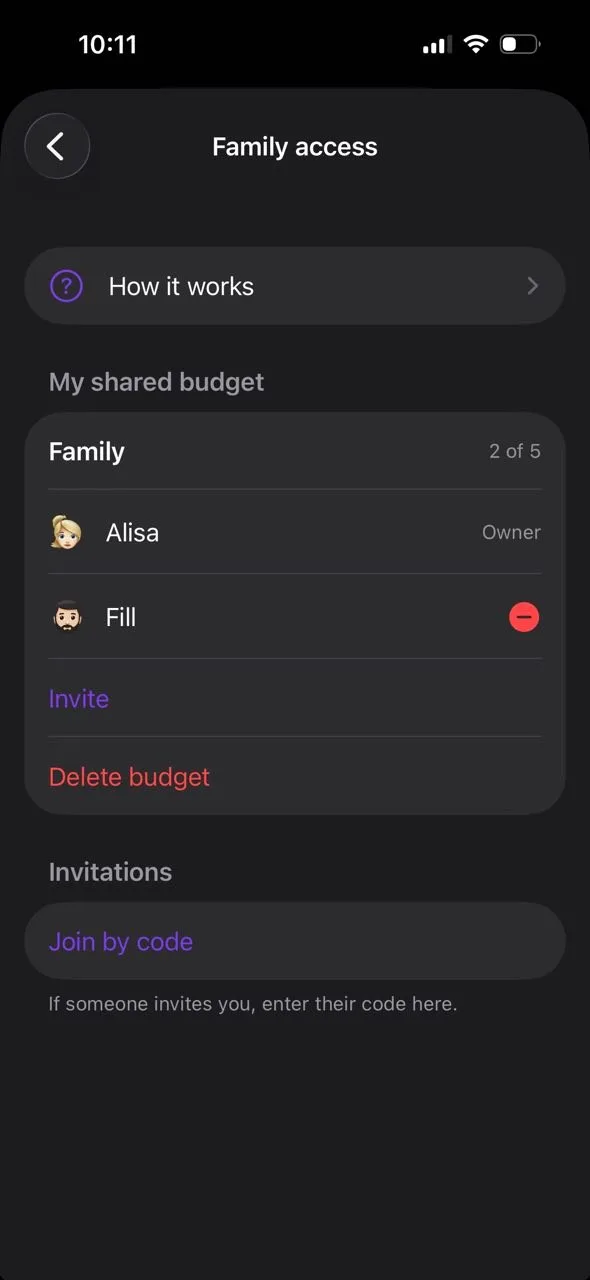
The simplest way to share a budget with a partner, family, or roommates is a shared view both people can see — not a stricter way of dividing costs. Most money friction between people who share expenses comes from unequal visibility, not from unfairness: one person tracks everything and the other is left guessing.
The fix isn’t calculating who owes what more precisely. It’s giving everyone the same live view, so there’s nothing left to reconstruct from memory.
Why shared money gets confusing
Most friction between couples or roommates managing money together comes down to one of three gaps, and none of them are about who’s more careful with money.
Unequal visibility. One person tracks everything and the other doesn’t, so one partner knows exactly where things stand while the other is guessing. That gap creates resentment on both sides — the tracker feels like the only one who cares, and the other feels shut out whenever the topic comes up.
Ambiguous categories. “Groceries” means something different to two people. If one person’s version of a grocery run includes takeout and the other’s doesn’t, “we’re over budget” turns into a debate about definitions before it can be a conversation about money.
No shared record. Without one place both people can check, spending becomes a memory contest — and people remember their own contributions more clearly than they remember someone else’s. That’s a documented bias, not a character flaw, and it’s enough on its own to cause a disproportionate number of money disagreements.
What actually helps — one shared view, not a settlement calculator
It’s worth being specific about what solves this and what doesn’t. An app that calculates who owes whom after the fact treats the symptom — it settles a disagreement that already happened. A shared budget view — one place where everyone logs their own spending and everyone sees the same running total — prevents the disagreement from needing to happen at all, because there’s nothing left to reconstruct or debate.
This doesn’t require merging every account. Each person can keep logging from their own phone, using their own cards; the shared view just means both people see the same categories, the same totals, and the same progress toward any shared goal, in real time.
Your personal budget stays separate
A common worry before setting up a shared budget is that it will absorb everything — every personal purchase suddenly visible to someone else. That’s not how a well-designed shared budget should work. Your personal accounts and transactions stay exactly where they are; a shared budget is a separate space you both add to on purpose, not a merger of your existing financial life. Nothing moves between the two automatically. You decide what goes into the shared view, transaction by transaction, and everything else stays private.
This distinction is worth confirming before you start, whatever app or method you use — it’s the difference between a tool that supports a healthy financial partnership and one that feels like it’s asking you to give up any financial independence.
Setting it up so it actually gets used
A shared budget works long-term when a few things are agreed on before the first transaction, not renegotiated after the first disagreement.
Decide what’s actually shared. Rent, utilities, groceries, and joint savings goals are common candidates. Personal spending — a hobby, clothes, coffee on the way to work — usually works better left out of the shared view entirely. Trying to track everything both people spend, including money that was never really joint, turns a shared budget into something that feels like surveillance instead of a tool.
Pick categories together, once. Don’t let one person’s mental model of “groceries” vs. “household” vs. “dining out” become the default just because they set things up first. A five-minute conversation up front avoids months of “why did you put that there” later.
Log it in the moment, not at the end of the week. The habit that survives long-term is the lightest one — add the transaction right after you pay, from your own phone, rather than trying to reconstruct a week of receipts on Sunday night.
For couples
A shared budget app for couples tends to work best with a hybrid approach: shared costs that are genuinely joint (rent, utilities, groceries, a shared savings goal), with each partner’s personal spending kept outside of it. This avoids the two most common failure modes — one partner feeling like every purchase needs to be justified, and the other having no visibility into where household money is actually going. The same setup works whether you’re a new couple merging finances for the first time or married couples who’ve shared accounts for years and just want a clearer shared picture.
It also helps to revisit the shared categories occasionally rather than setting them once and forgetting them. Spending patterns shift — a category that made sense the month you moved in together might not fit a year later.
For families
Family budgeting looks a little different from a two-person household — there are usually more categories (kids’ activities, school costs, a family vacation fund) and sometimes more than two adults contributing. The same principle still holds: one shared view beats everyone keeping their own mental tally. A family budget app that lets each parent (and older kids managing their own spending) log from their own phone avoids the single-bookkeeper problem, where one parent ends up as the household’s unofficial accountant by default rather than by choice.
Shared savings goals matter more here too — a family fund for a vacation, a big purchase, or an emergency cushion is easier to stay motivated about when everyone can see the same progress bar, not just the person who set it up.
For roommates
Roommates need a way to track shared expenses without one person becoming the unofficial bookkeeper everyone has to check in with. A shared budget view solves this the same way it does for couples and families — everyone logs their own contribution the moment they pay, and nobody has to reconstruct three months later who covered which bill.
The habit that matters most for roommates specifically is logging shared purchases immediately. With a couple, there’s usually an ongoing conversation that catches most gaps eventually. In a larger household, a purchase that doesn’t get logged the same day has a real chance of never getting logged at all — and that’s usually when things start feeling unfair, even when they aren’t. The fix isn’t more diligence, it’s lower friction: logging a transaction should take seconds, from whoever’s phone is already in their hand.
Setting savings goals together
Tracking shared expenses is only half of managing money with someone else — shared goals are the other half, and they’re the part people skip most often. A joint goal (a vacation, a security deposit, furniture for a shared space) works the same way a personal savings goal does: a target amount and a visual sense of progress, except now both people can see it without asking “how close are we?” — they can just look.
Setting the goal together, with an amount and rough timeline both people actually agree to, tends to matter more than which app or method you use to track it. A goal one person sets unilaterally rarely survives contact with the other person’s actual priorities.
A concrete example: a couple saving for a $3,000 vacation deposit split into monthly contributions has a very different experience watching a shared progress bar move together than each person guessing separately whether “we’re basically there yet.” The number itself doesn’t change — the shared visibility does, and that’s usually what determines whether the goal gets hit on schedule or quietly slips.
This article is for informational purposes and does not constitute financial advice.
Written by the Your Money team. We build tools to help people take control of their finances without giving up their privacy.
Frequently asked questions
- Does everyone need to pay for a shared budget app?
- No. Only the person who creates the shared budget needs a paid plan. Everyone they invite can join and use it for free — there's no separate subscription for each person.
- Does a shared budget calculate who owes who money?
- No, and that's a different tool. A shared budget gives everyone the same live view of spending and savings progress — it's for staying on the same page, not for settling up individual debts between people.
- What if my partner and I want to keep some spending separate?
- A shared budget doesn't have to mean every dollar is joint. Many couples track shared costs (rent, groceries, savings goals) in one place while keeping personal spending money separate and outside the shared view entirely.
- What happens to the shared budget if the person who created it stops paying for their subscription?
- The shared budget is tied to the creator's active subscription. If it lapses, the shared budget becomes inaccessible until it's renewed — this is worth knowing upfront if you're relying on a shared budget for ongoing household tracking.