 Your Money
How to Save for a Car or a House Down Payment
Saving for a car or a home feels different from saving “just in case.” There’s a specific thing you want, a rough price, and usually a timeline. That’s actually an advantage: a clear target can be turned into a clear monthly number, and a monthly number is something you can plan around.
The hard part is usually not the saving itself — it’s starting with the wrong target and finding out halfway through that the real number was much bigger.
Start with the real number, not the sticker price
The price you see advertised is rarely the amount you need to have saved.
For a car, the starting point depends on how you’re paying. If you’re buying outright, budget for the price plus sales tax, registration, and dealer fees, which vary a lot from state to state. If you’re financing, your savings goal is the down payment plus those upfront costs. A common rule of thumb is to put down around 20% on a new car — it lowers the monthly payment and makes it less likely you’ll owe more than the car is worth in the first couple of years, when it loses value fastest.
For a house, the goal has a few parts:
- The down payment itself
- Closing costs, commonly estimated at 2–5% of the loan amount
- Moving costs and the first repairs or furniture a new place almost always needs
On the down payment, 20% is the traditional benchmark because it avoids private mortgage insurance on a conventional loan. But plenty of buyers put down less — some conventional loans allow as little as 3%, and FHA loans 3.5% — in exchange for mortgage insurance and a higher monthly payment. Which route makes sense is a separate decision, but it’s worth making before you set the goal, because it changes the target dramatically.
Turn the target into a monthly amount
Once you have a realistic total, the math is simple: divide it by the number of months until you want to buy.
Two worked examples, with the assumptions spelled out:
- A $25,000 car with 20% down is $5,000, plus an estimated $1,500 for taxes and fees, for a total of $6,500. Saved over 18 months, that’s about $361 a month
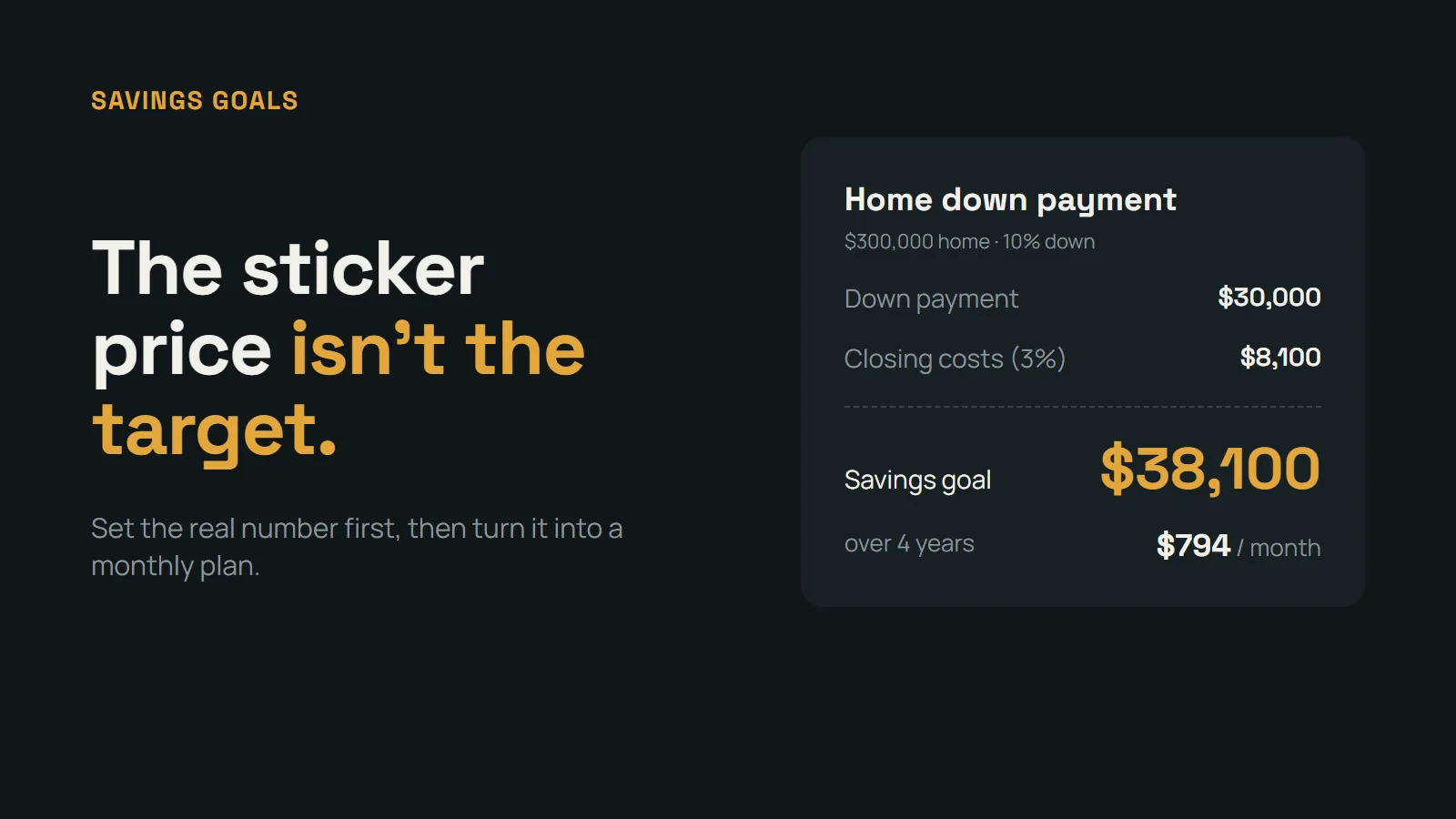
- A $300,000 home with 10% down is $30,000. Closing costs at 3% of the $270,000 loan add $8,100, for a total of $38,100. Saved over 4 years, that’s about $794 a month
If the monthly number looks impossible, you have three levers, and it helps to choose between them on purpose rather than just hoping:
- Stretch the timeline
- Lower the target — a less expensive car or home, or a smaller down payment percentage
- Free up more each month, either by cutting spending or adding income
Keep it separate from your emergency fund
It’s tempting to count your emergency savings toward a down payment, since it’s all money you’ve set aside. The problem shows up the first time something goes wrong. If one pot of money is doing both jobs, an unexpected bill either delays the purchase or leaves you with no cushion right after you’ve made a big financial commitment.
Most people find it works better to build a basic emergency fund first, then treat the car or home as its own separate goal with its own balance.
Where to keep the money while you save
For a purchase a few years away, the main priority is that the money is there when you need it. That’s why savings for near-term goals usually go into something stable and accessible, such as a high-yield savings account or CDs timed to mature around your purchase date. Investments like stocks can grow faster over long periods, but they can also drop sharply right before you’re ready to buy.
Keeping the goal money in a separate account from your everyday checking also helps. Money you don’t see every time you check your balance is much less likely to get spent by accident.
Make progress automatic, and visible
Two habits do most of the work:
- Set up an automatic transfer on payday, so the money moves before you have a chance to spend it
- Check your progress once a month. Watching the percentage climb is genuinely motivating, and it tells you early if you’re falling behind
Unexpected money — a tax refund, a bonus, a gift — is also worth splitting, with a portion going straight to the goal. A few of those over a year or two can noticeably shorten the timeline.
When the plan slips
A missed month isn’t a failed plan. Recalculate: either the monthly amount goes up slightly for the remaining months, or the target date moves back. Both are fine — what matters is that the plan reflects reality.
It’s also worth revisiting the target itself every few months. Car prices, home prices, and interest rates all move, and a goal set a year ago may need adjusting in either direction.
If you’re saving for a home or car together with a partner, the same approach works with one shared target. Sharing a budget with your partner covers how to set that up so both of you see the same progress.
Tracking it in Your Money
Savings goals in Your Money show how much you’ve put aside and how close you are to the target, with a progress bar that fills as you add to it. The free plan tracks one active goal at a time. Pro adds unlimited goals, so a car fund and a down payment fund can move forward side by side.
This article is for informational purposes and does not constitute financial advice. Your specific situation may call for a different approach — consider talking to a licensed financial advisor for guidance tailored to your circumstances.
Written by the Your Money team. We build tools to help people take control of their finances without giving up their privacy.
Frequently asked questions
- How much should I save for a house down payment?
- Putting down 20% avoids private mortgage insurance on a conventional loan, but many buyers put down less — some conventional loans allow 3% and FHA loans 3.5%. Whatever percentage you choose, add closing costs, which are commonly estimated at 2–5% of the loan amount.
- How much should I save before buying a car?
- If you're financing, a common rule of thumb is a down payment of around 20% on a new car, which lowers the monthly payment and reduces the chance of owing more than the car is worth early on. Also set aside money for upfront taxes and fees, which vary by state.
- Should I use my emergency fund for a down payment?
- Generally no. If your emergency fund doubles as your down payment, an unexpected expense either delays the purchase or leaves you without a cushion right after a big move. Most people keep the two as separate goals and build a basic emergency fund first.
- Where should I keep money I'm saving for a car or house?
- For goals a few years away, most people prioritize keeping the money safe and accessible over chasing growth — for example, a high-yield savings account or CDs timed to when you'll need the money. Investments like stocks can drop in value right when you're ready to buy.